
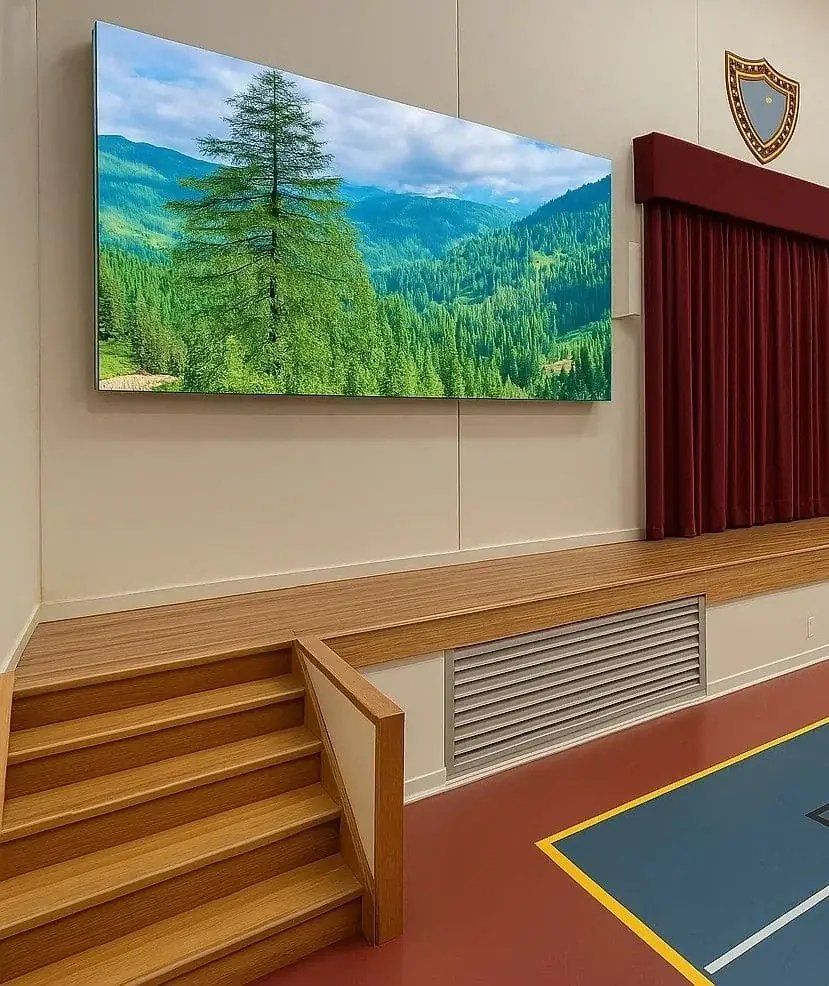
Every December the same thing happens in sanctuaries from Suntree to downtown Melbourne. The Christmas Eve candlelight service fills every pew, the house lights stay up so people can read, and the projector that looked fine in September turns into a gray rectangle. The lyrics are there, technically. Nobody in the back half of the room can read them. If your worship pastor has been asking about an LED wall, this is the month that question gets answered, and this guide covers what a church LED wall actually involves, what sits behind it, how to phase the work before Christmas, and what it costs.
Why churches outgrow the projector
Projectors were the right answer when the alternative was a felt board. They are still the right answer in a dark room. The problem is that most Brevard County sanctuaries are not dark rooms. The older congregations in Eau Gallie and along US-1 in Rockledge and Cocoa were built with tall windows and east-facing glass, and the newer Viera campuses have lobbies and side walls full of natural light. A projector fights that light and loses, so the usual fixes are to close the blinds, dim the room, or keep buying brighter lamps.
The costs stack up quietly. A lamp or laser module every few years, a cleaning schedule for the filter, a screen that yellows, and a contrast ratio that was never good enough for white text on a dark background. By the time a church has replaced the projector twice, it has spent a meaningful fraction of what a direct-view LED wall would have cost, and it still has washed-out lyrics.
What a direct-view LED wall does for a sanctuary
A direct-view LED wall is made of panels that emit their own light, so there is no lamp, no screen and nothing for ambient light to wash out. The lights can be all the way up for a reading or a children's program and the words stay crisp. That is the whole argument in one sentence, but a good church video wall installation is about three decisions that follow from it.
Pixel pitch is the distance between LEDs, measured in millimeters. A finer pitch means a sharper image up close and a higher price. The right pitch is set by the distance from the wall to the front pew, not by the balcony. A sanctuary where the first row sits 15 feet from the platform can use a 2.5 to 2.9 mm pitch comfortably. A long, narrow sanctuary where the front pew is 30 feet back can step up to 3.9 mm and save real money with no visible difference from the seats.
The second decision is layout. A single center wall behind the platform gives the room one focal point and works well for lyrics, sermon notes and the livestream camera shot. Two side screens flanking a cross or baptistry preserve the architecture of an older sanctuary and give the sound booth two independent feeds. Many of the Suntree and Viera churches we talk to want the center wall. The older downtown Melbourne congregations often want the side screens so the chancel stays the chancel.
The third is brightness. Indoor LED panels run from roughly 600 to 1,500 nits. A sanctuary with big windows wants the upper end so the wall holds at an 11 a.m. service in July, then gets dimmed for the Christmas Eve candlelight service. Running a bright wall at 40 percent also extends its life.
The media system behind the wall
The wall is the visible part. What makes Sunday morning run smoothly is the system feeding it, and it is closer to a broadcast setup than to the conference room AV most volunteers have seen at work. A typical sanctuary build includes:
- Presentation software such as ProPresenter for lyrics, scripture, sermon slides and video, run from a dedicated machine in the booth rather than someone's laptop
- A video switcher so the camera feed for the livestream and the image on the wall come from the same place, which keeps the online congregation and the room in sync
- An LED processor that scales the content to the exact pixel count of the wall, handles brightness scheduling and keeps the panels calibrated
- Confidence monitors facing the platform so the worship team sees the next lyric and the pastor sees sermon notes without turning around
- Signal distribution over fiber or HDBaseT from the booth to the wall, since the run is almost always longer than HDMI will reliably carry
Looking for reliable AV and IT support in Brevard County? The Electpros serve Melbourne, Palm Bay, Viera, Titusville, and the entire Space Coast with same-day availability. Call (321) 655-PROS or book a free consultation at theelectpros.com.
Power, rigging and the structural check an older sanctuary needs
This is the part that decides whether the wall goes in before Christmas or after Easter. An LED wall is heavy, often 8 to 12 pounds per square foot before the frame, and it either hangs from the structure above or mounts to a wall that was never designed to carry it. The 1960s and 1970s block sanctuaries in Eau Gallie, downtown Melbourne and along US-1 in Cocoa usually need an engineer to look at the platform wall or the roof trusses before anyone orders panels. Newer tilt-wall buildings in Viera and West Melbourne are simpler, but a ground-supported frame is sometimes still the right call.
Power is the other early item. A mid-size wall draws a few kilowatts at full brightness, and it should be on dedicated circuits, with the processor and booth equipment on a UPS so a Florida summer flicker does not reboot the system mid-service. We coordinate the electrical with a licensed electrical contractor and handle the low-voltage, rigging and AV side ourselves.
Phasing the install so it lands before Christmas Eve
The churches that get a wall in before Christmas do it in phases. Phase one is the structural check, power, the mounting frame and the cabling from the booth, which can all happen during the week with no impact on Sunday. Phase two is the panels, processor and switcher, usually a two to three day install with a full test on a weekday evening so the worship team can rehearse on it. The fellowship hall displays, the children's wing screens and the lobby signage are a clean phase three in January, when the budget resets and the rush is over.
Panel lead times in late November run two to four weeks for common pitches, so a church that signs off the first week of December can realistically have the sanctuary wall lit for Christmas Eve if the structural work is already cleared.
How much does an LED wall for a church cost?
Honest ranges, because this is the question every finance committee asks first:
- Small sanctuary wall, roughly 10 to 12 feet wide at 2.5 to 2.9 mm pitch, with processor, mounting and basic integration into an existing booth: $25,000 to $45,000 installed
- Mid-size center wall, 14 to 18 feet wide, with a new switcher, confidence monitors and fiber distribution: $50,000 to $85,000
- Large sanctuary wall of 20 feet or more at a finer pitch, with engineered rigging, dedicated power and a full media system: $80,000 to $150,000 and up
Two side screens generally cost a bit less than one center wall of equal total area because each is smaller and easier to mount. If the church is weighing LED against a tiled LCD wall for a fellowship hall or lobby, our earlier post on LED versus LCD video walls walks through that comparison. For the sanctuary itself, LED wins on brightness and seamlessness almost every time.
A good LED wall should run 10 years or more with no lamp, no bulb and no filter, which is the number to put next to the projector line in the budget.
Get the sanctuary ready before the candles are lit
The Electpros design and install LED walls and the media systems behind them for churches across Brevard County, from the Suntree and Viera campuses to the older congregations in Eau Gallie, downtown Melbourne, Rockledge and Cocoa. We will measure the room, check the structure and power, pick a pitch the front pew will be happy with, and lay out a phased plan that gets the sanctuary lit before Christmas Eve with the fellowship hall and children's wing to follow. Call (321) 655-PROS or book a free site visit at theelectpros.com and we will come look at the room this week.