
It is the question we get asked in almost every living room we walk into. Somebody has decided the TV audio is not cutting it anymore, they have read the words 5.1 and Atmos somewhere, and now they want to know how many speakers they actually need before they commit to holes in the ceiling.
The honest answer is that the number matters less than where those speakers go and how the wire gets to them. We install surround systems all over Brevard County, from Suntree bonus rooms to new builds off Borrego Drive in Viera West, and the difference between a system that disappears into the room and one that sounds like a stereo with extra steps almost always comes down to placement and prep, not speaker count.
How Many Speakers Do You Need for Surround Sound?
Every surround system is described by a set of numbers. The first number is your ear-level speakers, the second is subwoofers, and the third, when there is one, is your overhead height channels. Here is what each tier actually gets you:
- 5.1: three speakers across the front, two at the sides or slightly behind you, one subwoofer. This is the baseline and it is genuinely good. For most Brevard living rooms in the 14 by 18 foot range, this is the right answer.
- 7.1: adds a pair of rear surrounds behind the seating. Worth it only if you have real distance behind the couch, which usually means a dedicated media room rather than an open great room.
- 5.1.2 or 5.1.4: adds two or four in-ceiling height speakers for Dolby Atmos. This is where in-ceiling speakers stop being a convenience and start being the whole point, since Atmos needs sound coming from above you.
If you are still weighing whether to go this route at all, we broke down the tradeoff in detail in our post on soundbars versus true surround sound. Most people land on 5.1.2 as the sweet spot: real surround, plus overhead, without turning the ceiling into a pegboard.
Why In-Ceiling Speakers Make Extra Sense in a Florida Home
In-ceiling and in-wall speakers are popular everywhere, but they solve problems that are specific to how houses get built here.
Most Brevard homes are block construction with drywall furred out over the exterior walls, which means there is often no usable cavity to put a speaker in on an outside wall. The ceiling, on the other hand, is almost always open truss space. That flips the usual approach. In a northern house you might run everything in the walls. In a Malabar or Bayside Lakes home, the ceiling is the path of least resistance and the attic is your friend, at least in January.
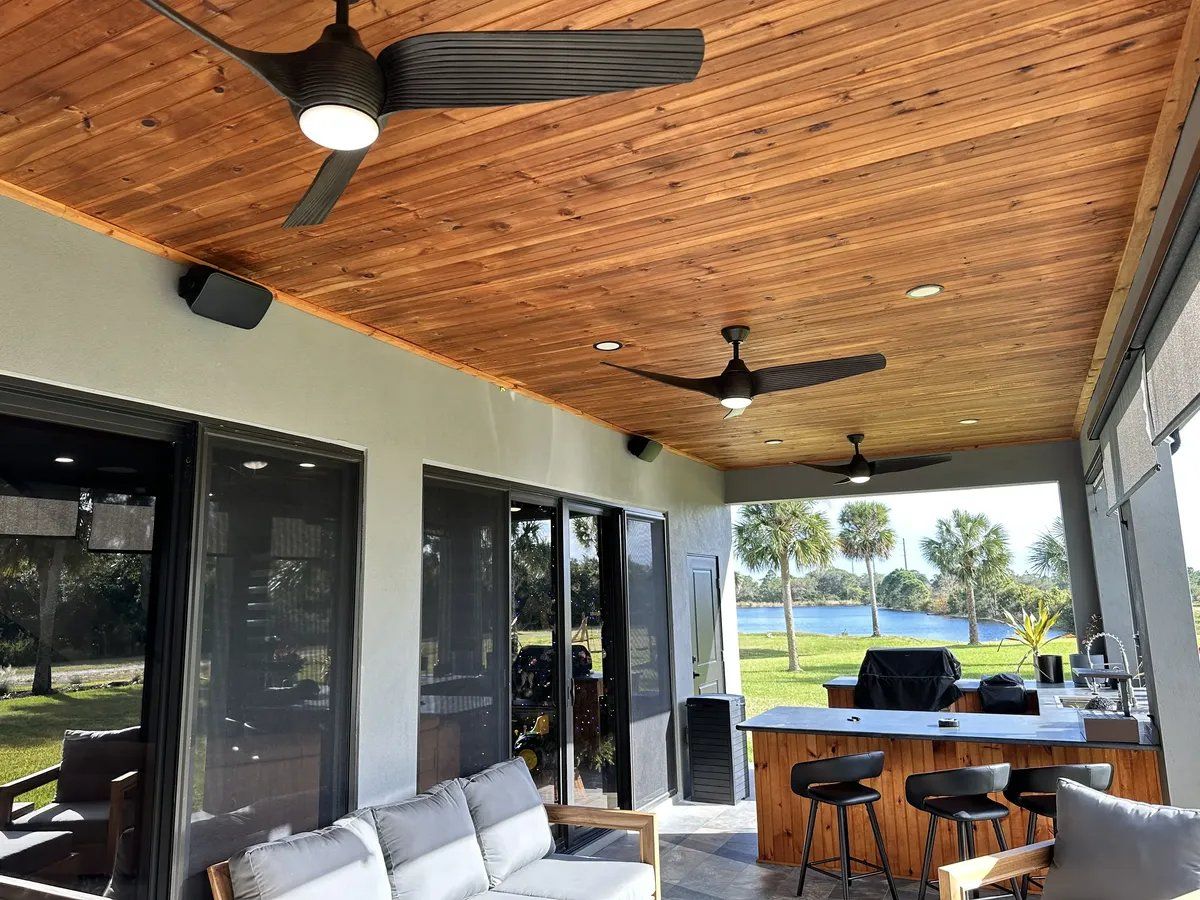
There is also the furniture problem. Open floor plans with sliders out to a lanai do not leave you many walls to put a tower speaker against, and nobody wants a speaker stand blocking the path to the pool. Going in-ceiling gives you the channel count without giving up the room.
Two things to know before you commit. First, ask for speakers with a pivoting tweeter so the high frequencies can be aimed at the seating instead of straight down at the coffee table. Second, in a humid attic, a backer box or at minimum a moisture-rated enclosure is not optional. We have pulled out plenty of ten-year-old speakers where the cone had gone soft because the back of it sat exposed to attic air all summer.
Ready to get real surround sound into your living room? The Electpros serve all of Brevard County, from Melbourne and Palm Bay to Viera and Titusville, with same-day and next-day availability. Call (321) 655-PROS or book online at theelectpros.com.
Running the Wire Without Tearing the House Apart
This is the part that decides your budget. Pulling speaker wire in a house that is already finished is very doable, but how doable depends on the house. In a single-story home with an accessible attic, which describes most of Suntree, Rockledge off Barton Boulevard, and the older sections of Port Malabar, we can usually get every run done through the attic with small, patchable access points. Our home theater installation crews do this weekly.
Where it gets harder:
- Two-story homes where the theater is downstairs. The ceiling above you is a floor, not an attic, and the joist bays may run the wrong direction.
- Concrete ceilings in beachside condos in Cocoa Beach, Indialantic, or Melbourne Beach. There is no cavity at all, so the answer is usually in-wall fronts plus on-wall or bookshelf surrounds instead of in-ceiling.
- Vaulted and tray ceilings, common in Viera East and Addison Village. Very doable, but the angle changes the placement math and you want that figured out before the first hole.
Use 14 gauge wire for anything over about 40 feet, and run in-wall rated cable, not the zip cord that came in the box. It costs a little more and it is the only part of this system you cannot upgrade later without opening the ceiling again.
Placement Is What Actually Makes It Sound Right
You can buy excellent speakers and get a mediocre result by putting them in the wrong spot. A few rules we hold to:
- Surrounds go at or slightly above ear level when seated, roughly in line with or just behind the couch. Not in the back corners of the room.
- Atmos height speakers go in front of and behind the seating, not directly overhead. Directly overhead is the single most common mistake in a DIY install.
- The center channel does the heavy lifting on dialogue. If you have to spend more on one speaker, spend it there.
- Keep the subwoofer off the wall by at least a few inches, and be willing to move it. Corner placement gets you more bass and worse bass.
Then calibrate. Every modern receiver has a room correction routine and a microphone in the box, and skipping it undoes a lot of careful work. It takes ten minutes and it is the cheapest upgrade in the entire project.
Good Timing If You Have Snowbirds Arriving
Late September and October are the right window for this work. Seasonal owners start landing in Brevard County from late October through November, and ceiling work is the kind of job you want finished and painted before anybody is living in the house. We see the same pattern every year on Tropical Trail in Merritt Island and in the barrier-island homes from Satellite Beach down to Melbourne Beach: a property manager calls in the fall, we do the audio, the network, and the cameras in one trip, and the owner walks into a house that already works. Our whole-home audio services pair naturally with the rest of the residential technology work while the walls are already open.
If you are in south county, Grant-Valkaria or Micco, where the lots are big and service calls are worth batching, that is doubly true.
Give us a call at (321) 655-PROS and tell us about the room. We will tell you honestly whether you need five speakers, seven, or whether the smarter move is a strong 5.1.2 that fits the space you actually have.