
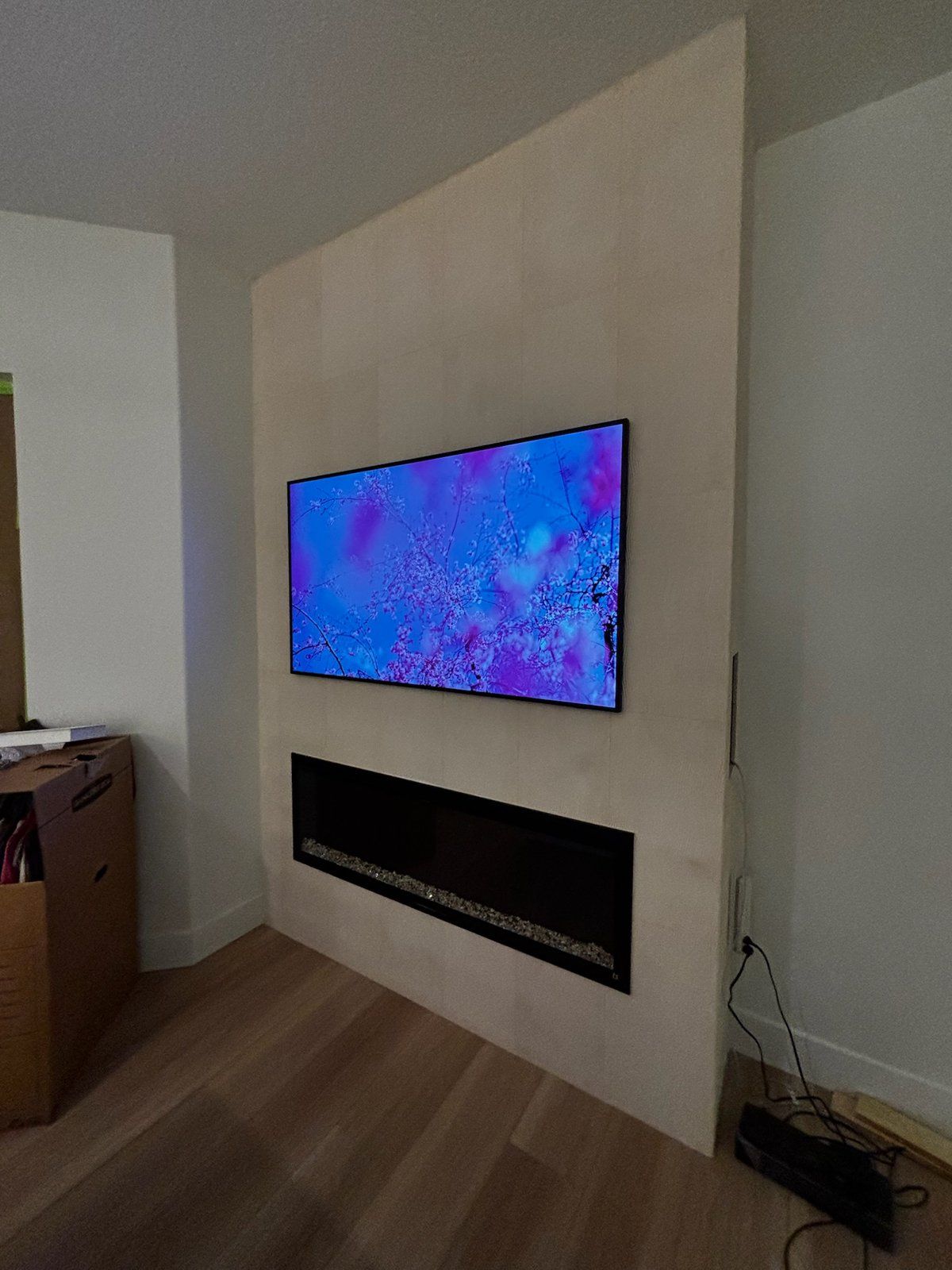
The projector searches finally showed up. Over the past couple of months, people across Brevard County have been typing "projector screen" and "projector for streaming nearby" into Google, and a lot of those searches are coming from the same kind of room: a bonus room in Suntree or Viera with a wall of sliders, or a dedicated media room on a bigger lot in Grant-Valkaria or Malabar. If you already decided a projector is right for you, we covered the projector versus TV decision back in September, and this post is not going to re-argue it. This one is about the part most people get wrong after they order the projector: the screen.
A 4K laser projector pointed at a bare wall or a cheap pull-down screen in a bright Florida room looks worse than a mid-range TV. The same projector on the right screen, sized for the seats and built to reject ambient light, is the best picture you can put in a house. Here is how we size, choose, and install screens for homes from Melbourne and Palm Bay up to Titusville.
What Size Projector Screen Do I Need?
Start with the seating distance, not the wall. The most common mistake we see in Brevard County bonus rooms is a screen that is too big for the room, bought because the wall could hold it. For 4K content, a comfortable rule is that the screen's diagonal should be roughly 40 to 50 percent of the distance from the screen to the main seat. In practice that works out like this:
- Seats 10 feet back (120 inches): a 100 to 110 inch diagonal screen fills the view without making you turn your head during a football game.
- Seats 12 feet back (144 inches): 120 inches is the sweet spot, and it is the single most common size we install in Viera and Suntree.
- Seats 14 to 15 feet back: 135 to 150 inches, which is dedicated media room territory, the kind of space we see in Grant-Valkaria and Malabar homes with a room built for it.
Aspect ratio matters too. Almost everything you stream, from Netflix to YouTube TV to the game, is 16:9, so a 16:9 screen is the right call for a streaming-first room. A 2.35:1 "cinemascope" screen looks dramatic, but every streaming show and sporting event will play with black bars on the sides, and most families regret it. We only recommend 2.35:1 when the owner is a movie-first viewer who understands the trade.
Fixed-Frame, Motorized, or Tab-Tensioned: Which Screen Belongs in Your Room?
Fixed-frame screens
A fixed-frame screen is a rigid aluminum frame with the material stretched flat and wrapped in black velvet. It is the flattest, most consistent surface you can get, it never ripples, and it has no motor to fail in Florida humidity. If the screen can live on the wall permanently, this is the best picture per dollar. It is our default for dedicated media rooms in Grant-Valkaria and Malabar, and for any Viera bonus room where the owner is fine with the screen being the room's focal point.
Motorized screens
A motorized screen drops from a ceiling or wall-mounted case and retracts when you are done. We install these in Suntree and Baytree great rooms where a 110 inch black rectangle would fight the decor, and the screen comes down over a window wall or a mounted TV only at movie time. The trade is that an inexpensive motorized screen will develop waves and curl at the edges within a year or two, and you will see them in every bright scene.
Tab-tensioned motorized screens
This is the fix for that problem. Tab-tensioned screens have cables running down each side that pull the material perfectly flat every time it drops. If you want a screen that disappears and you want it to look like a fixed-frame when it is down, this is the one. It costs more, but in our experience it is the only motorized screen worth buying for a 4K laser projector.
Why ALR Material Is the Difference in a Florida Bonus Room
This is the section that saves people from a disappointing projector. Florida rooms have light. A Suntree or Viera bonus room almost always has a slider or a bank of windows, and even with blinds drawn, the daytime light bouncing around that room will wash out a standard white screen. The image goes gray, the blacks go milky, and the owner concludes that projectors are not bright enough. The projector was fine. The screen was wrong.
Ambient-light-rejecting, or ALR, material is engineered to reflect light coming from the projector back toward the seats while absorbing or deflecting light that hits it from the sides and above. In a room with sliders, a good ALR screen is the difference between a usable daytime picture and one that only works after sunset. For a ceiling-mounted or shelf-mounted long-throw projector, you want a standard ALR screen. For an ultra-short-throw projector sitting on a credenza right under the screen, you need a UST-specific ALR screen that rejects light from above, because a standard ALR screen will actually make a UST projector look worse.
Screen gain is the other spec on the box, and it is simpler than it sounds. A gain of 1.0 reflects the same light as a plain white reference surface. A gain of 1.3 bounces about 30 percent more light toward the center seats, which helps in a bright room but can narrow the viewing angle so the people on the ends of the sectional see a dimmer picture. Most ALR screens land between 0.6 and 1.2, and the lower numbers are not a flaw. A gray ALR screen with 0.8 gain will look darker on paper and deliver far better contrast in a room with any light in it. We match gain to the projector's brightness, the room, and how wide the seating is.
Ready to get a projector screen sized and installed right? The Electpros serve all of Brevard County, from Melbourne and Palm Bay to Viera and Titusville, with same-day and next-day availability. Call (321) 655-PROS or book online at theelectpros.com.
What a Streaming-First Projector Setup Needs in the Rack
Most of the projector rooms we build in Brevard County are not Blu-ray rooms anymore. They are Apple TV or NVIDIA Shield rooms, feeding a 4K laser projector, with a streaming service doing the heavy lifting. That still needs a plan, because a projector mounted 14 feet from the source is a different animal than a TV with everything plugged into its back.
- A proper HDMI path. A 4K HDR signal at 60 frames per second, with Dolby Vision from an Apple TV, will not survive a 40 foot bargain HDMI cable. We run a certified active or fiber HDMI cable from the rack to the projector, or an HDMI over Cat6 extender so a future projector swap is plug-and-play.
- An AV receiver or a Sonos Arc Ultra with eARC as the audio hub. The projector has no speakers worth using, so audio has to come back to the rack. A receiver gives you full surround. A soundbar with HDMI eARC keeps the system simple for a family room.
- A hardwired network drop. Streaming 4K to a projector over Wi-Fi in a room with a slider full of radio-frequency noise is asking for buffering. We run Ethernet to the rack and to the Shield or Apple TV.
- A single remote or app. The projector, the receiver, the lights, and the motorized screen should all respond to one button. A proper control setup means the screen drops, the lights dim, and the projector fires when you press Play.
If the room is being built from the ground up, our home theater installation team handles the wiring, the screen, the projector mount, and the control system as one project. If you already have a TV on the wall in a Suntree great room and want a motorized screen to drop in front of it at movie time, that is a job our TV mounting services crew sees every month, and it is very doable in an existing home.
Getting the Screen Right the First Time
The pattern is consistent across every projector room we install in Melbourne, Viera, and Palm Bay. The people who love their projector sized the screen for the seating, chose a screen that stays flat, picked ALR material because they were honest about the light in the room, and ran a real HDMI and network path to the rack. The frustrated ones bought the biggest cheap pull-down screen that fit the wall and expected the projector to beat a Florida afternoon.
If you are planning a bonus room in Viera, finishing a media room in Grant-Valkaria, or getting a seasonal home in Melbourne Beach ready for the family's arrival next month, we are glad to come out, measure the room, and recommend a specific screen size and material before you buy anything. Call (321) 655-PROS or book online, and let's make the projector look like it is supposed to.