
Anyone who has lived on the Space Coast through a few summers knows the lightning here is not a figure of speech. Central Florida gets more strikes per square mile than almost anywhere in the country, and Brevard County sits on the eastern end of that corridor. Add a hurricane season that runs through November 30, with Milton in October 2024 still fresh in memory, and October is the month to ask what is actually protecting your home's electronics.
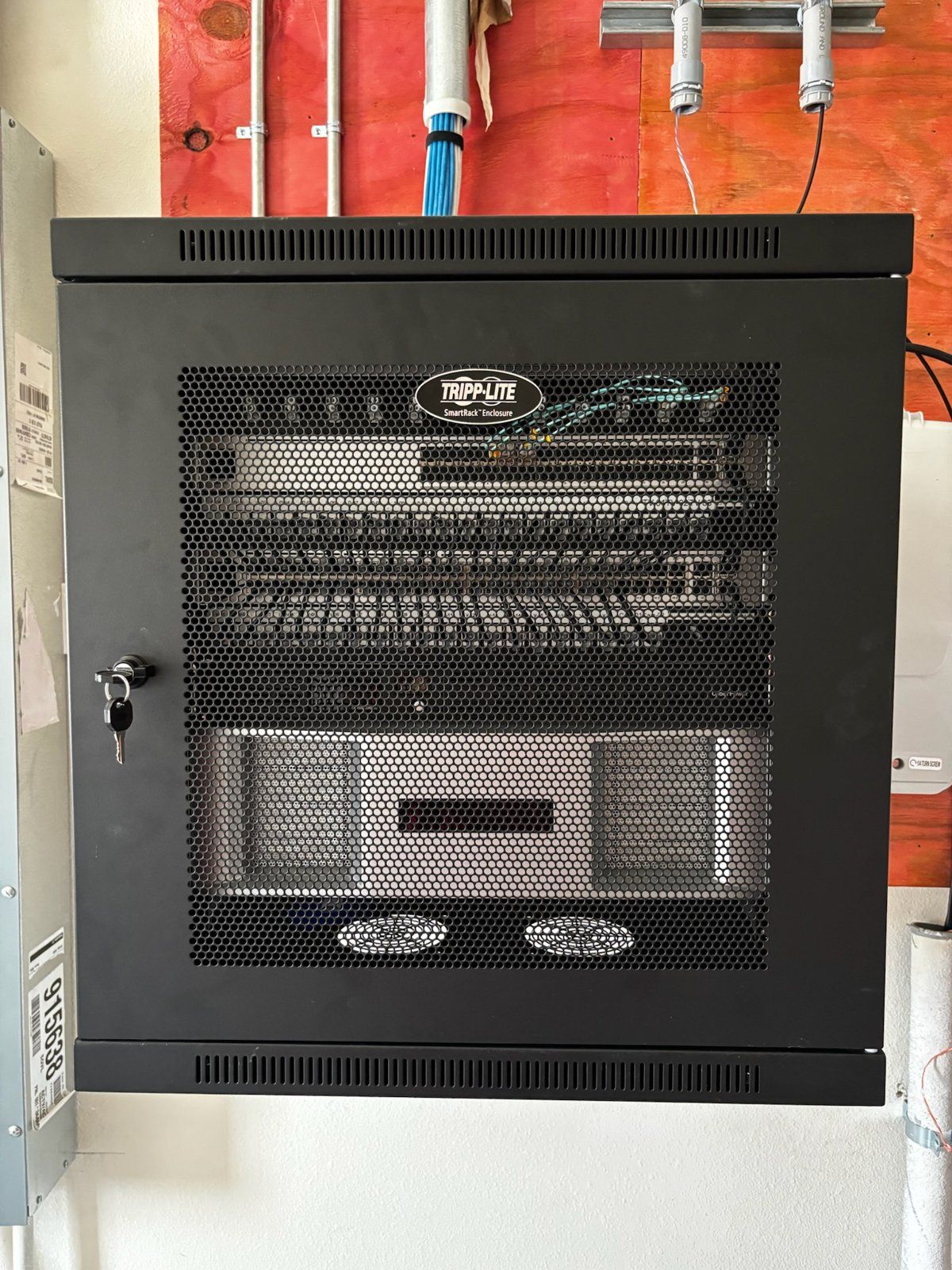
Most homes we work in across Melbourne, Palm Bay, and Viera now have real money on the wall and in the closet: a 4K laser projector, a Sonos system, Unifi cameras with an NVR, a rack of switches and streaming boxes. Then we look at what it is plugged into and find a $20 power strip. That is not protection. Here are the three layers that are, and why The Electpros can do all three in-house.
Is whole-house surge protection worth it?
Yes, and in Brevard County it is the cheapest insurance you will ever buy for your electronics. A whole-house surge protective device (SPD) mounts at your main panel and clamps big surges before they reach a branch circuit. Those surges come from more than direct hits. A strike on a pole two streets over, a utility switching event, a transformer failing on Malabar Road, even your own AC compressor cycling, all push spikes into the wiring. The panel unit takes the brunt so everything downstream sees far less.
Here is what matters for homeowners in Bayside Lakes and Port Malabar: installing a whole-house surge protector is electrical work. It wires into the panel on its own breaker and has to be done by a licensed electrical contractor. The Electpros holds a Florida electrical contractor license (EC13014608), so when we design your network or theater we install the surge protection at the panel on the same visit. Most AV and IT companies have to send you to someone else for that step, and in our experience that step quietly never happens.
What a surge actually does to a projector or NVR
A surge does not always announce itself with a bang. We have replaced projectors in Viera West that were simply dead after a storm, but the more common damage is cumulative. Every small spike that gets through degrades the power supply and the components inside your gear a little more. The projector that throws a color wheel error eight months later, the NVR drive that develops bad sectors, the switch where two ports stop working, those are surge damage too. They just happen slowly enough that nobody connects the dots.
The three layers every serious AV and network home needs
Each layer handles what the one above it lets through, and an NVR with outdoor camera cables can take a surge on the data side as easily as the power side, so one device is never enough.
- Layer 1, at the panel: A whole-house SPD rated for Florida lightning exposure, installed on a dedicated breaker by a licensed electrician. This stops the large surges that would overwhelm anything smaller.
- Layer 2, at the rack: A quality point-of-use surge protector or power conditioner feeding your network rack and theater gear. Look for a high joule rating, a clamping voltage of 330V or lower, and an indicator that tells you when the protection has been used up. This catches what the panel unit lets through and cleans up the smaller noise that makes audio hum and video flicker.
- Layer 3, battery backup: An uninterruptible power supply (UPS) sized for your router, switch, NVR, and PoE cameras. This rides through the flickers that are so common during afternoon storms, gives you a clean, automatic shutdown in a real outage, and keeps the cameras and Wi-Fi up when you most want to see the house.
Why is a $20 power strip not protection? Many have no surge suppression at all; they are extension cords with a switch. The ones that do use a single small varistor that sacrifices itself on the first real surge and then keeps passing power with no indication it is now just a strip. If yours has been through a couple of Florida summers, assume it is done.
Ready to protect the gear you have already invested in? The Electpros serve all of Brevard County, from Melbourne and Palm Bay to Viera and Titusville, with same-day and next-day availability. Call (321) 655-PROS or book online at theelectpros.com.
Why a UPS matters most during a storm
This is where power protection stops being about equipment and starts being about you. When a storm sits over the barrier island and a Satellite Beach homeowner is two states away, the one thing they want is to pull up the cameras and see the house. The power flickers three times in an afternoon, which is normal here, and without a UPS the NVR reboots each time, the router drops, and the recordings have gaps in exactly the window that matters.
With a properly sized UPS on the home network rack, the modem, router, switch, and NVR never notice the flicker. In a longer outage, a 1,500VA unit typically keeps a modest network and camera system running for 30 to 60 minutes, then signals the NVR to shut down cleanly so the hard drive is not corrupted. We covered the remote-monitoring side in our guide to getting a seasonal home's technology ready before you arrive, and a UPS is the piece that makes the rest of it dependable.
One sizing note from jobs in Viera West and Bayside Lakes: put the network and cameras on the UPS and leave the amplifiers on the conditioner only. Batteries for audio amps get expensive fast, and a projector should always be allowed to run its cooling fan and shut down on its own.
Dedicated circuits: the step most installers skip
When a receiver, a subwoofer amp, and a rack of gear share a bedroom circuit with the vacuum and a hair dryer, you get voltage sags, breaker trips, and ground loops that show up as hum through the speakers. A dedicated 20-amp circuit for the rack solves most of it. Because we are the electrical contractor as well as the AV installer, we pull that circuit while we run the speaker wire and camera cable, and it passes inspection as one job. If you are planning a home theater in Palm Bay or Melbourne Beach, ask about this up front; it is far cheaper during the install than after the drywall is closed.
The same goes for security cameras. A PoE switch on a clean, protected circuit with battery backup is the difference between a camera system that records the storm and one that records up until the storm.
Protect it once, before the next storm
Late-season hurricanes and summer lightning are part of living in Brevard County. Your equipment can handle that climate, but only if the power feeding it is protected at the panel, at the rack, and with a battery in between. The Electpros design and install all three layers, and as a licensed Florida electrical contractor we do the panel work ourselves. Whether you are in a new build off Borrego Drive in Viera, a waterfront home in Port Malabar, or a beachside home in Satellite Beach, call (321) 655-PROS or book online at theelectpros.com and we will protect what you have already built.