
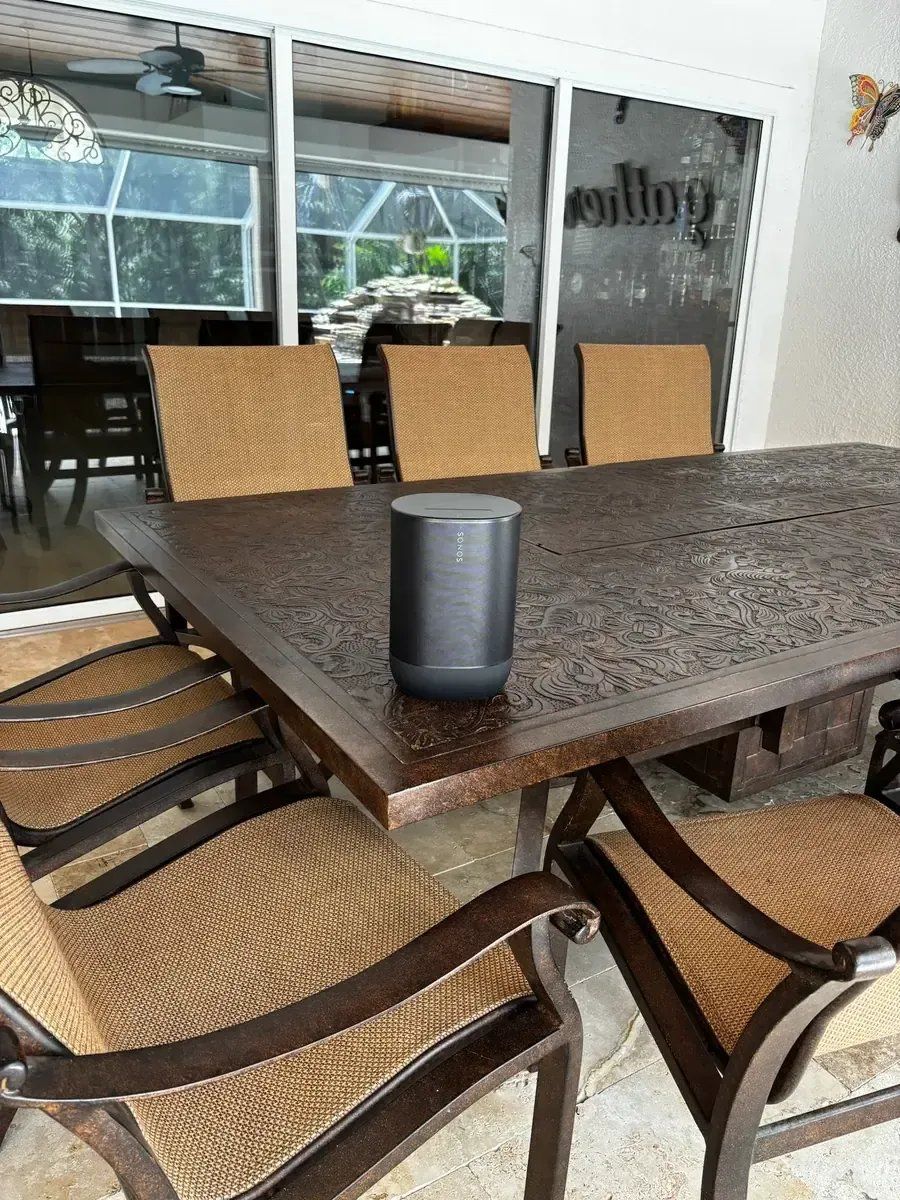
If you are shopping for a whole-home audio system in Brevard County, the first decision is not which speaker sounds best. It is whether the speakers should sit on shelves or disappear into the ceiling. Both approaches run on Sonos, both play from the same app, and both can cover a house from the great room to the pool. They are built very differently, though, and the right answer depends on the house, how far along construction is, and how you want the rooms to look when you are done.
What do I need for a whole-home audio system?
At the simplest level, a whole-home audio system needs three things: a source (streaming services, a turntable, or the TV), something to play it in each room, and a network solid enough to hold it all together. How you fill in the middle part is where the two approaches split.
A standalone Sonos system uses powered speakers like the Era 100, Era 300, and Five. Each one has its own amplifier inside, plugs into a wall outlet, and joins your Wi-Fi. You set them on a shelf or counter, group them in the app, and you are done. No wiring, no rack, no holes in the drywall.
Architectural audio uses in-ceiling and in-wall speakers that have no amplifier of their own. Speaker wire runs from each pair back to a central equipment rack, where a Sonos Amp drives each zone. The Amp is the brain and the muscle. Everything in the room is a flush white grille that paints to match the ceiling. Our whole-home audio installation work in higher-end homes is almost always this second approach, usually with a mix of both where it makes sense.
When standalone Sonos is the right call, and when it is not
Standalone speakers are the right fit when the house is finished, the ceilings are hard to get into, and you want music in three or four rooms without a construction project. A Cocoa Beach condo with concrete ceilings is the classic case. An Era 100 in the kitchen, a Five in the living room, and a Move on the balcony go in during one afternoon.
They stop being the right call when the room count climbs. Eight powered speakers means eight outlets, eight Wi-Fi devices, and eight objects sitting on furniture in a house where you paid for clean sightlines. In a waterfront home on Tropical Trail or Rockledge Drive, the view out the back is the whole point of the room. A speaker on the console competes with it. A pair of in-ceiling speakers does not.
Architectural audio also wins outside. Powered Sonos speakers are fine on the lanai but not through a Florida summer bolted to a soffit. Outdoor in-wall and landscape speakers are built for that and driven from the Amp inside, where the electronics stay cool and dry.
How zones get laid out in a Brevard County home
A zone is any area that plays its own music at its own volume. In a typical four-bedroom in Addison Village or Lamplighter Village in Viera, we usually land on five or six zones, each on its own Sonos Amp:
- Great room: one pair of in-ceiling speakers, or two pairs if the room is long and opens to the kitchen. This zone often doubles as the TV audio, with the Amp taking HDMI ARC from the display.
- Kitchen and dining: its own pair so dinner prep can play something different from the game in the great room.
- Primary suite: one pair in the bedroom, and often a small pair in the bathroom so the shower gets the same music.
- Lanai: two or four outdoor-rated in-wall or surface speakers under the roofline, aimed at the seating, not out into the yard.
- Pool and landscape: satellite speakers tucked into the planting beds paired with an in-ground landscape subwoofer. The sub carries the low end so the small speakers can play at a volume you can talk over without blasting the neighbors.
A Melbourne Beach pool home with a long lanai and a separate pool deck shows why the sub matters. Without it, you turn the patio speakers up to reach the pool and the lanai gets loud. With four landscape satellites and one buried sub around the deck, the pool has its own coverage and the lanai stays at conversation level.
Ready to get whole-home audio laid out properly? The Electpros serve all of Brevard County, from Melbourne and Palm Bay to Viera and Titusville, with same-day and next-day availability. Call (321) 655-PROS or book online at theelectpros.com.
What the wiring looks like: new construction versus an existing home
In new construction off Borrego Drive in Viera, or any house still at framing, this is the easy version. We run 16-gauge speaker wire from every speaker location to one closet before drywall, add a Cat6 drop to each TV and the rack, and leave a conduit to the lanai. The rack can be a shallow wall-mounted unit in a laundry room. Pre-wire costs little compared with opening walls later.
In a finished home the wire still gets there, it just takes a different path. Single-story homes in Suntree and Baytree with attic access are the simplest, because we drop wire from the attic to each ceiling speaker and fish it back to a closet. Two-story homes take more planning. Block-wall homes on the barrier island may need a short run of exterior conduit. We walk the house before quoting so there are no surprises in the attic.
Either way, every Sonos Amp should be on Ethernet, not Wi-Fi, so a dozen zones never compete with the kids' iPads for bandwidth. If the house still runs on the ISP's gateway, our home networking services usually get folded into the same visit. If the great room is also getting surround sound, the two systems share the rack, and our guide on how many in-ceiling speakers surround sound needs covers that side.
Controlling it from Ohio before you land
For seasonal owners this is the part that matters most. Sonos runs from one app, and that app works from anywhere with an internet connection, not just inside the house. A snowbird sitting in Columbus in late October can open the app, see that every zone is online, and have the lanai playing before the car is in the driveway.
The same app covers standalone speakers and Amp-driven zones, so in-ceiling audio indoors and a portable Move for the dock show up as one system. If you run Control4 or AVA for lights, shades, and the home theater, Sonos drops into that too, so volume and source live on the same screen as everything else.
Two things keep remote control working from 900 miles away: the rack on a UPS so a power flicker does not take the network down, and the router set to come back online on its own. We set both up on every install.
Getting it scheduled before the season
Late October into November is when the calendar fills with seasonal owners who want the house ready. In-ceiling audio across a finished home takes a walk-through and a day or two of attic work, so booking now keeps you ahead of the arrivals. For a new build, get us in before drywall and the hard part is done for good.
Call (321) 655-PROS or book online at theelectpros.com and we will walk the house, map the zones, and quote the whole thing in one visit.